Article Link: https://pubs.acs.org/doi/10.1021/acs.chemrev.6c00026
Our Review paper “Relay Catalysis in Selective Transformations of C1 into C2+ Molecules” has been published in Chemical Reviews.
With a history spanning more than a century, research in C1 chemistry has mainly focused on the conversion of CO and CH4 into high-value hydrocarbons. Unlike CH4, CO cannot be supplied from nature but can be manufactured from coal, natural gas, biomass, and even carbon-containing waste. The production of CO is usually accompanied by the generation of H2, and thus, syngas is a versatile platform for chemical utilization of various carbon resources for producing hydrocarbon chemicals and fuels. Another important C1 molecule is methanol, with an annual production of 170 million tonnes, primarily synthesized from syngas. Several commercialized catalytic processes using C1 molecules as feedstocks are based on methanol, such as methanol-to-olefins (MTO), methanol-to-aromatics (MTA), methanol carbonylation, and synthesis of formaldehyde. On the other hand, the extensive utilization of fossil resources has led to massive CO2 emissions, resulting in abnormal climate change. Many countries have established roadmaps toward carbon neutrality. With the fast development of sustainable technologies, the conversion of CO2 into high-value chemicals using green hydrogen or electricity is becoming practicable.
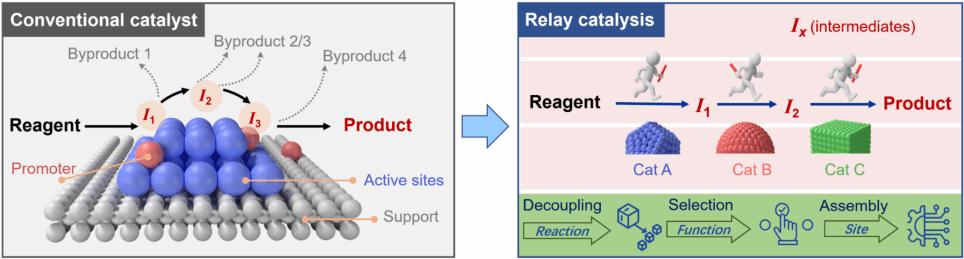
Currently, most conventional heterogeneous catalysts mainly consist of the active phase, promoter, and support. Catalytic performance can be tuned through the regulation of active phase size, morphology, valence state, metal-support interaction, and geometric structure, making it applicable to a wide range of important chemical conversions. However, this catalyst design concept is difficult to apply to some challenging and complicated catalytic reactions, resulting in poor product selectivity. Relay catalysis provides a solution for better controlling the reaction processes towards precision catalysis. The core of relay catalysis involves designing a single reaction pathway with few controllable steps guided by specific intermediates, selecting the optimal and compatible functional components for each reaction step, and assembling them into one reactor for synthesizing desired products.
We appreciate the financial support from the National Key Research and Development Program of Ministry of Science and Technology (No. 2022YFA1504600), the National Natural Science Foundation of China (Nos. 22121001, U25B6005, 22222206, U22A20392, 22502077, and 22372136), Fundamental Research Funds for the Central Universities (20720250081). This work is dedicated to the 100th anniversary of the FT synthesis.
